
Tagliatelle Bolognese, also known as Tagliatelle al Ragù, is one of the most famous traditional pasta dishes from the Italian region of Emilia-Romagna. This authentic recipe combines fresh egg pasta with a rich, slow-cooked ragù alla Bolognese, creating a dish that has become a symbol of Italian cuisine around the world.
Thanks to its deep flavor and comforting texture, tagliatelle with ragù is perfect for a family meal but also elegant enough for a Sunday lunch or special occasion.

Tagliatelle are a classic fresh egg pasta typical of the culinary tradition of Emilia-Romagna. They are made with a simple dough of flour and eggs, rolled into thin sheets and cut into long ribbons. This traditional pasta shape is ideal for holding rich sauces such as ragù alla Bolognese.
In this recipe you will learn how to prepare both the authentic Bolognese ragù and homemade tagliatelle from fresh pasta dough, then combine them into one of the most iconic dishes of Italian cooking.
Jump to:
Ingredients for Tagliatelle Bolognese
- Prep Time: 30 Min. If you want to make homemade tagliatelle you need 1 extra hour
- Cook Time: 2 H 20 Min for bolognese sauce + 5 Min for Tagliatelle
- Servings: 4
For Homemade Tagliatelle
Doses for about 500 g (1.1 lb) tagliatelle
- 200 g (1 ⅓ cup) "00" Flour
- 200 g (1 ⅓ cup) semolina flour
- 4 eggs of at least 70 g (2.5 oz) each. Fresh homemade pasta usually wants 1 egg x 100 g ⅔ cup) of flour.
For Ragù alla Bolognese
- 300 g (10 oz) ground beef
- 150 g (5 oz) sliced pancetta (you can replace pancetta with minced pork)
- 1 small carrot
- 1 celery stalk
- 300 g (1 ¼ cup) tomato passata or crashed peeled tomato
- 1 small onion
- 100 ml (½ cup) dry white wine
- 300 ml (1 ½cup) meat broth
- 3 tablespoons extra virgin olive oil
- 100 ml (½ cup) whole milk
- Salt, to taste
- Freshly ground black pepper, to taste
To Serve
- Grated Parmigiano Reggiano, to taste
How to Make Ragù alla Bolognese

Step 1) - Cut the carrot, celery and onion into very small pieces and set aside. Then finely chop the pancetta.
Place the chopped pancetta in a saucepan. Cook over medium heat for about 3 minutes, stirring occasionally.

Step 2) - Now add the extra virgin olive oil and the finely chopped vegetables. Stir and cook over medium heat for about 5 minutes.

Step 5) - Then add the ground beef. Stir and cook for about 5 minutes over medium heat. Now add the white wine. Stir and let it evaporate.

Step 6) - Finally, add the tomato passata. Cover with a lid and simmer for about 2 hours. If the sauce becomes too dry during cooking, add a little broth. Toward the end, add milk to dampen the acidity of the tomato. Adjust salt and pepper to taste.
The Bolognese sauce is ready! You can use it right away, store it in the refrigerator or freeze it.
For more information, curiosities and tips, read the full recipe: how to make Authentic Bolognese Sauce.

How to Make Fresh Tagliatelle Pasta
While bolognese sauce is slowly simmering, prepare the Homemade Tagliatelle.
NOTE: Of course, you can use packaged Tagliatelle. But if you have the time and inclination, I recommend that you prepare them at home by following the steps below. It will be a real success!
To make homemade tagliatelle I used a KitchenAid Stand Mixer. But any stand mixer will do. If you want to know how to knead by hand, read our recipe How to Make Homemade Pasta.

Step 1) - First, sift the two flours and combine them together. Pour the two sifted flours into the steel bowl. Then add the eggs.
With the flat "leaf" whisk set to speed 2 on the caster and mix the ingredients together for half a minute.

Step 2) - Now remove the flat "leaf" whisk and insert the dough hook.

Step 3) - Still at speed 2, knead for 2 -3 minutes until a single firm dough ball is formed.
Now, dust the work surface with semolina. Remove the dough from the bowl and knead by hand for 2 minutes.

Step 4) - Form a ball of dough, wrap it with plastic wrap or in a tea towel. Let it rest for about 20 minutes.
Then cut a piece of dough and flatten it with your hands.

Step 5) - Attach the sheeter to your stand mixer and proceed with the dough sheet. Set the knob of the sheeter to level 1 and at speed 2, put the dough into the rollers and pass it the first time.

Step 6) - Then fold the dough in half and then in half again.

Step 7) - Flour and pass through rollers again. Repeat 3-4 times (pass-fold-pass-fold) until the dough becomes smooth and elastic.
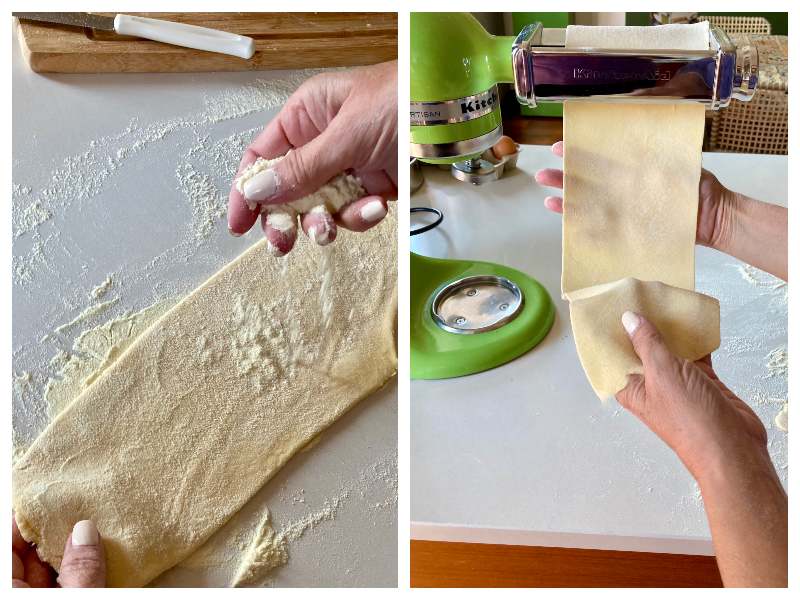
Step 8) - At this point DO NOT make any more folds and start thinning the sheets by passing them through the smooth roller to position 2 and finally 3. When the sheet becomes too long cut it into 2 parts.
The Tagliatelle

Step 9) - Now move on to the preparation of the tagliatelle. Remove the sheeter from your KitcheAid and attach the tagliatelle tool.
At speed 1 insert the sheeter and with your other hand, pick up the tagliatelle.

Step 10) - Gather the tagliatelle with your hands and lay them on a tray floured with semolina.
Divide the tagliatelle into portions of about 50 g (1,8 oz) and roll them on your hand to form nests.
Tagliatelle are now ready to be cooked!
How to Cook and Serve Tagliatelle Bolognese

Step 1) - Place a pot of water on high heat and add a tablespoon of coarse salt.
When the water comes to a boil, throw in the noodles and count 3 minutes from when the water resumes boiling (about 5 minutes in total). If you have bought noodles, cook them the time indicated on the package.
PLEASE NOTE: Cooking should have these proportions: 1 liter (4 cups) of water, 100 g (3,5 oz) of pasta, and 10 g (½ tablespoon) of salt.
READ: How to Cook Fresh Pasta

Step 2) - Drain tagliatelle al dente and toss them with plenty of Ragù alla Bolognese.
Serve tagliatelle alla bolognese bringing grated Parmigiano cheese to the table and more Ragù alla Bolognese to add on top as desired.

Storage
You can store cooked tagliatelle topped with Bolognese sauce in the refrigerator, sealed in an airtight container, for up to one day.
To reheat, add a tablespoon of water and a drizzle of oil. Reheat in the microwave or stir-fry them.
Make Bolognese Sauce in Advance
It's possible to make Bolognese Sauce in advance and reheat it at the appropriate time. Ragù can be stored in the refrigerator in a tightly closed food container for up to 2-3 days.
You can freeze the ragu and store it in the freezer for up to 1 month.
Make Tagliatelle in Advance
You can store fresh tagliatelle in the refrigerator for up to 1 day. Or we recommend that you divide the noodles into small nests of about 50 g (1,8 oz) each, place well-spaced on a tray and then freeze them.
DO NOT THAW to cook them. Instead, drop the tagliatelle noodles into boiling water while still frozen.

Why Is Bolognese Served with Tagliatelle and Not Spaghetti?
In the traditional cuisine of Bologna, ragù alla Bolognese is always served with fresh egg pasta such as tagliatelle, not spaghetti. The reason is simple: tagliatelle have a wide, slightly rough surface that holds the rich meat sauce much better.
Spaghetti, which are smooth and thinner, cannot capture the ragù in the same way. This is why in Bologna the classic combination is tagliatelle al ragù, one of the most iconic dishes of Italian cuisine.
Origins of Tagliatelle al Ragù
Tagliatelle al ragù alla Bolognese has very ancient and almost aristocratic origins.
According to a famous legend, tagliatelle were created in 1487 for the wedding of Lucrezia Borgia and the Duke of Ferrara. The court cook, Zafirano, is said to have been inspired by the bride’s long blond hair to invent this new ribbon-shaped pasta. Tradition even says that the perfect width of tagliatelle should be about 8 mm (⅓ inch).
At that time pasta was made entirely by hand. The dough was rolled out very thin with a rolling pin, then gently rolled and cut into ribbons with a sharp knife. This traditional technique is still used today to make many fresh egg pasta shapes, including wider cuts such as pappardelle.
The name tagliatelle comes from the Italian verb “tagliare,” meaning “to cut.”
Bolognese sauce also has noble origins. It appeared on the tables of wealthy families in Bologna as early as the 16th century.
It's not certain exactly when tagliatelle and ragù alla Bolognese were first served together. What is certain is that their combination created one of the most famous dishes of Italian cuisine, known and loved all over the world.
More Italian Fresh Pasta Recipes
- How to Make Fresh Fettuccine
- Creamy Pumpkin Tagliatelle
- Fettuccine alla Papalina
- Tortellini in Brodo
- Meat Ravioli Recipe
- Lasagna Bolognese Recipe

Recipe Card

Authentic Tagliatelle Bolognese Recipe (Italian Tagliatelle al Ragù)

Ingredients
For Homemade Tagliatelle
- 200 g "00" flour - 1 ⅓ cup
- 200 g semolina flour - 1 ⅓ cup
- 4 eggs - at least 70 g (2.5 oz) each. Fresh homemade pasta usually wants 1 egg x 100 g ⅔ cup) of flour.
For Bolognese Sauce
- 300 g ground beef - 10 oz
- 150 g sliced pancetta or minced pork - 5 oz
- 1 small carrot
- 1 stalk celery
- 300 g tomato passata (strained tomato) - 1 ¼ cup, or crashed peeled tomato
- 1 small onion
- 100 ml dry white wine - ½ cup
- 300 ml meat broth - 1 ½ cup
- 3 tablespoons extra virgin olive oil
- 100 ml whole milk - ½ cup
- salt - to taste
- freshly ground black pepper
To Serve
- grated Parmigiano Reggiano - to taste
Instructions
THE BOLOGNESE SAUCE
- Cut the carrot, celery and onion into very small pieces and set aside. Then finely chop the pancetta.
- Place the chopped pancetta in a saucepan. Cook over medium heat for about 3 minutes, stirring occasionally.
- Add the extra virgin olive oil and the finely chopped vegetables. Stir and cook over medium heat for about 5 minutes.
- Add the ground beef. Stir and cook for about 5 minutes over medium heat. Now add the white wine. Stir and let it evaporate.
- Finally, add the tomato passata. Cover with a lid and simmer for about 2 hours. If the sauce becomes too dry during cooking, add a little broth. Toward the end, add milk to dampen the acidity of the tomato. Adjust salt and pepper to taste.
THE PASTA DOUGH
- Sift the two flours and combine them together. Pour the two sifted flours into the steel bowl. Then add the eggs.
- With the flat "leaf" whisk set to speed 2 on the caster and mix the ingredients together for half a minute.
- Remove the flat "leaf" whisk and insert the dough hook. Still at speed 2, knead for 2 -3 minutes until a single firm dough ball is formed.
- Dust the work surface with semolina. Remove the dough from the bowl and knead by hand for 2 minutes.
- Form a ball of dough, wrap it with plastic wrap or in a tea towel. Let it rest for about 20 minutes. Then cut a piece of dough and flatten it with your hands.
- Attach the sheeter to your stand mixer and proceed with the dough sheet. Set the knob of the sheeter to level 1 and at speed 2, put the dough into the rollers and pass it the first time.
- Then fold the dough in half and then in half again.
- Flour and pass through rollers again. Repeat 3-4 times (pass-fold-pass-fold) until the dough becomes smooth and elastic.
- At this point DO NOT make any more folds and start thinning the sheets by passing them through the smooth roller to position 2 and finally 3. When the sheet becomes too long cut it into 2 parts.
THE TAGLIATELLE
- Move on to the preparation of the tagliatelle. Remove the sheeter from your KitcheAid and attach the tagliatelle tool. At speed 1 insert the sheeter and with your other hand, pick up the tagliatelle.
- Gather the tagliatelle with your hands and lay them on a tray floured with semolina. Divide the tagliatelle into portions of about 50 g (1,8 oz) and roll them on your hand to form nests. Tagliatelle are now ready to be cooked!
COOKING AND SEASONING
- Place a pot of water on high heat and add a tablespoon of coarse salt. When the water comes to a boil, throw in the tagliatelle and count 3 minutes from when the water resumes boiling (about 5 minutes in total). If you have bought them, cook for the time indicated on the package.
- Drain tagliatelle al dente and toss them with plenty of Ragù alla Bolognese. Serve tagliatelle alla bolognese bringing grated Parmigiano cheese to the table and more Ragù alla Bolognese to add on top as desired.
Mark says
Another excellent recipe.