
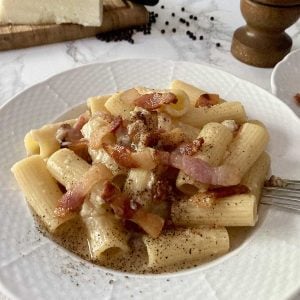
Authentic Pasta alla Gricia recipe is one of the oldest and most iconic dishes of Roman cuisine. Originating in the area of Amatrice, in Lazio, this traditional pasta is often described as the tomato-free ancestor of Amatriciana.
Made with just four essential ingredients—pasta, guanciale, Pecorino Romano and black pepper—Gricia represents the purest expression of Roman culinary tradition. Its simplicity is deceptive: the balance between rendered guanciale fat and sharp Pecorino creates a creamy and intensely savory sauce without the addition of eggs or tomatoes.

Some refer to it as “Amatriciana Bianca” because it shares the same base ingredients as Amatriciana, except for the tomatoes. In fact, Pasta alla Gricia predates the arrival of tomatoes in Europe and is considered the historical foundation of one of the four classic Roman pasta recipes.
Traditionally prepared with rigatoni or mezze maniche, Gricia can also be made with spaghetti or bucatini.
Below, you’ll learn how to prepare authentic Pasta alla Gricia exactly as it is served in traditional Roman osterias.
Jump to:
Ingredients

Prep Time: 10 Min | Cook Time: 15 Min | Servings: 4
- 350 g ( 12 oz ) rigatoni (traditional) or mezze maniche
- 200 g ( 7 oz ) guanciale, cut into strips
- 110 g (1 cup) Pecorino Romano DOP - finely grated, plus more to serve
- Freshly ground black pepper, to taste
Kitchen Tools and Equipment
- CUTTING BOARD: A sturdy cutting board is essential for safely slicing guanciale into even strips.
- KNIFE: Use a sharp kitchen knife to cut through both the lean and fatty parts cleanly.
- PEPPER GRINDER: Freshly ground black pepper is essential for authentic Pasta alla Gricia. Avoid pre-ground pepper. A grinder with adjustable settings allows you to control the coarseness.
- CHEESE GRATER: Pecorino Romano should be finely grated so it melts properly when tossed with the pasta. A hand grater or rotary grater works best for hard cheeses.
- NON-STICK PAN: Use a wide, heavy-bottomed pan to finish cooking the pasta. It allows the rendered guanciale fat and cheese to coat the pasta evenly.
Instructions
Make the Sauce

Step 1) - Bring a large pot of water to a boil and salt it lightly. Pecorino Romano is naturally salty, so avoid over-seasoning the water.
Finely grate the Pecorino Romano and set aside. Do not use pre-grated cheese.

Step 2) - Cut the guanciale into thick strips or small chunks.
Place it in a cold skillet and turn the heat to medium. Cook slowly so the fat renders gradually.

Step 3) - When the fat becomes translucent and the guanciale turns lightly golden, let it crisp gently for 2–3 minutes.
Remove the guanciale with a slotted spoon and set aside, leaving the rendered fat in the pan.
Cook the Pasta

Step 4) - Cook the pasta (rigatoni or mezze maniche) until al dente. Drain it about 2 minutes before the suggested cooking time.
Before draining, add a ladle of starchy pasta water to the pan with the guanciale fat. Stir to create the base of the sauce. The cooking water, which is loaded with starch, will make the pasta creamier.
Season and Finish

Step 5) - Drain and transfer the pasta directly into the pan. Toss over low heat to coat it evenly in the rendered fat.
Turn off the heat completely before adding the grated Pecorino Romano. Pecorino Romano gives this dish its signature flavor. Discover how it differs from other cheeses in Pecorino Romano vs Parmigiano Reggiano

Step 6) - Add a small ladle of reserved pasta water and stir vigorously. The starch in the water will bind with the Pecorino, creating a smooth, creamy emulsion without lumps.
Once the sauce is velvety and evenly coating the pasta, return the crispy guanciale to the pan and toss briefly.

Step 7) - Finish with freshly ground black pepper and serve immediately with extra Pecorino Romano.

How to Make Gricia Creamy
Pasta alla Gricia becomes creamy thanks to a simple but precise technique: the emulsification of rendered guanciale fat, grated Pecorino Romano, and starchy pasta water.
The key is temperature control. You must add the cheese only after turning off the heat. If the pan is too hot, Pecorino will seize and form clumps instead of melting smoothly.
Use less pasta water than usual when boiling the pasta. This creates starch-rich water, which helps bind the cheese and fat together. Add it gradually while stirring vigorously until a smooth, velvety sauce forms.
The result should not be watery or greasy. A proper Gricia sauce lightly coats each piece of pasta, creating a creamy texture without the use of eggs, cream, or butter.
Storage
Enjoy Pasta alla Gricia immediately, served hot and freshly made. The sauce is based on a delicate emulsion of Pecorino and guanciale fat, which tends to thicken and lose its creamy texture once cooled.
For this reason, Gricia should not be prepared in advance.
If necessary, store the leftovers in the refrigerator for up to one day. Reheat gently in a pan over low heat with a small splash of water to help restore some of the creaminess.

Tips
GUANCIALE: Authentic Pasta alla Gricia is made with guanciale, the cured pork jowl typical of central Italy. Its high fat content is essential to create the creamy emulsion with Pecorino and pasta water. You can use pancetta if guanciale is unavailable, but the result will be less rich. Avoid smoked bacon.
PASTA SHAPE: Rigatoni and mezze maniche are the most traditional choices because their ridges hold the rendered fat and cheese. Spaghetti or bucatini are also common, especially in Rome, but short ridged pasta enhances the texture of the sauce.
PECORINO ROMANO: Use well-aged Pecorino Romano DOP and grate it finely. Add it only after turning off the heat to prevent clumping.
PASTA WATER: Use starch-rich pasta water to bind the sauce. Add it gradually while stirring to create a smooth, creamy consistency.
SALT BALANCE: Guanciale and Pecorino are naturally salty. Season the pasta water lightly to avoid overpowering the dish.
The Four Classic Roman Pasta Dishes
Pasta alla Gricia is the historical foundation of the four classic Roman pasta dishes:
- Pasta alla Gricia – the original tomato-free base made with guanciale and Pecorino Romano
- Amatriciana – Gricia with the addition of tomatoes
- Carbonara – Guanciale combined with eggs and Pecorino
- Cacio e Pepe – The simplest expression of Roman pasta, focused on cheese and black pepper
Together, these four recipes define the core of Roman pasta tradition.

Origins
Pasta alla Gricia is one of the oldest pasta dishes of central Italy. Its origins are traditionally linked to the area of Amatrice, between Lazio and Abruzzo, where shepherds carried simple, durable ingredients such as guanciale, dried pasta, Pecorino and black pepper during transhumance.
Long before tomatoes were introduced to Europe, these ingredients were combined to create a rustic dish that many regard as the ancestor of Amatriciana.
The name “Gricia” may derive from the nearby village of Grisciano, although other theories connect it to the Roman dialect word gricio, referring to bread and food merchants. While the exact origin of the name remains uncertain, the recipe itself has remained remarkably simple and unchanged over time.
Pasta alla Gricia Recipe: FAQs
Pasta alla Gricia is made with guanciale, Pecorino Romano and black pepper. Amatriciana uses the same base ingredients but adds tomatoes. For this reason, Gricia is often considered the ancestor of Amatriciana.
No. Cacio e Pepe is made only with Pecorino Romano and black pepper. Gricia includes guanciale, whose rendered fat creates a richer and more savory sauce.
Rigatoni and mezze maniche are the most traditional choices because their ridges hold the sauce well. Spaghetti or bucatini are also commonly used.
Guanciale is essential for the authentic flavor of Gricia. Pancetta can be used if necessary, but the texture and taste will differ. Smoked bacon should not be used.
More Traditional Roman Pasta Recipes
- Penne all'Arrabbiata (Italian Spicy Tomato Pasta)
- Pasta alla Checca (Roman Fresh Tomato Pasta)
- Spaghetti Aglio, Olio e Peperoncino
Recipe Card
Authentic Pasta alla Gricia Recipe – The Original Roman Sauce

Ingredients
- 350 g rigatoni or mezze maniche - 12 oz
- 200 g guanciale - 7 oz
- 110 g Pecorino Romano DOP - 1 cup
- freshly ground black pepper - to taste
Instructions
- Bring a large pot of water to a boil and salt it lightly. Pecorino Romano is naturally salty, so avoid over-seasoning the water.
- Finely grate the Pecorino Romano and set aside. Do not use pre-grated cheese.
- Cut the guanciale into thick strips or small chunks.
- Place it in a cold skillet and turn the heat to medium. Cook slowly so the fat renders gradually. When the fat becomes translucent and the guanciale turns lightly golden, let it crisp gently for 2–3 minutes.
- Remove the guanciale with a slotted spoon and set aside, leaving the rendered fat in the pan.
- Cook the pasta (rigatoni, mezze maniche, or spaghetti) until al dente. Drain it about 2 minutes before the suggested cooking time.
- Before draining, add a ladle of starchy pasta water to the pan with the guanciale fat. Stir to create the base of the sauce.
- Drain and transfer the pasta directly into the pan. Toss over low heat to coat it evenly in the rendered fat.
- Turn off the heat completely before adding the grated Pecorino Romano.
- Add a small ladle of reserved pasta water and stir vigorously. The starch in the water will bind with the Pecorino, creating a smooth, creamy emulsion without lumps.
- Once the sauce is velvety and evenly coating the pasta, return the crispy guanciale to the pan and toss briefly.
- Finish with freshly ground black pepper and serve immediately with extra Pecorino Romano.
Dave says
This was amazing! After much anxiety, my cheese finally came together at the end. I followed the instructions to the T. Really really very good! I will definitely make this again.
Mike says
Very nice recipe. I deviated slightly by adding 2oz of black winter truffle per serving (my hat's off to the Australians...we can have this treat twice per year now!)
salvatore sclafani says
If you right click on your mouse, you will see a print option. Among the choices is print a pdf. Then you can save the whole recipe and discussion on your computer without the paper!