
Homemade tomato passata is one of the simplest and most useful staples of Italian cooking. Traditional passata di pomodoro is made with just one main ingredient: ripe, flavorful tomatoes. They are briefly cooked, then passed through a food mill or tomato press to remove the skins and seeds, creating a smooth, vibrant tomato purée.
Unlike a ready-made tomato sauce, Italian passata is not seasoned or cooked with onions, garlic, or herbs. It is simply pure tomato, although in some Italian families a few fresh basil leaves are added for extra aroma. This simplicity makes passata an incredibly versatile base for pasta sauces, pizza, soups, stews, and countless other Italian recipes.
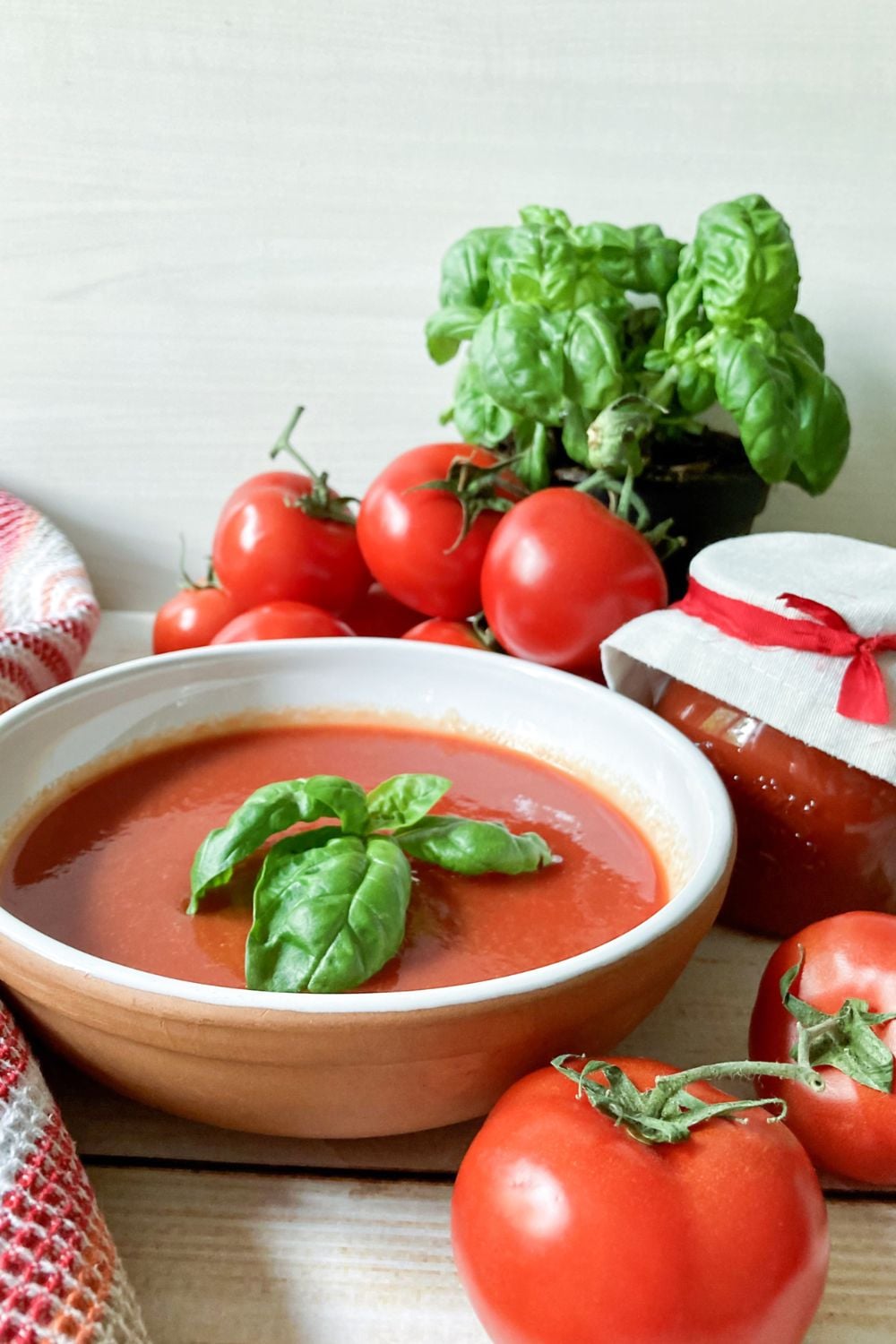
In Italy, making tomato passata is a traditional late-summer ritual, when tomatoes are at their ripest, sweetest, and most abundant. Many families prepare large batches to preserve the flavor of summer tomatoes and use them throughout the year.
Making tomato passata at home is surprisingly easy and gives you complete control over the quality of the tomatoes you use. In this recipe, I'll show you how to make authentic Italian tomato passata from fresh tomatoes, with tips for choosing the best varieties and for storing or preserving it safely.
Jump to:
- Ingredients
- Kitchen Tools and Equipment
- How to Make Tomato Passata
- What Are the Best Tomatoes for Passata?
- How to Store Homemade Tomato Passata
- How to Preserve Tomato Passata Safely
- Tomato Passata Variations
- How to Use Tomato Passata
- What Is Tomato Passata?
- Tomato Passata vs Tomato Sauce vs Tomato Purée
- More Italian Tomato Recipes
- Recipe Card
Ingredients
Prep Time: 30 Min | Cook Time: 20 Min | Yield: about 500–700 ml (2–3 cups)
- 2 Kg (4 lb 6 oz) very ripe, flavorful tomatoes, such as San Marzano, Roma, or other good-quality sauce tomatoes
Kitchen Tools and Equipment
To make homemade tomato passata, the most useful tool is a tomato strainer, which separates the tomato pulp from the skins and seeds and gives the passata its characteristic smooth texture.
For larger batches, an electric tomato strainer makes the process much faster. I use a machine similar to the Weston Deluxe Electric Tomato Strainer.
For smaller quantities, you don't need a special machine. A traditional food mill works very well and is a practical option for home cooking. I recommend the OXO Good Grips Food Mill, which comes with different grinding discs.
You will also need:
- A large pot for cooking the tomatoes.
- A large bowl to collect the passata.
- A fine-mesh strainer, optional, if you want to remove some excess liquid and obtain a thicker passata.
- Clean glass jars or bottles if you plan to store the passata.
How to Make Tomato Passata

Step 1) - Choose very ripe, red tomatoes without bruises or damaged areas. Wash them thoroughly under running water, remove the stems, and cut them in half.

Step 2) - Using a small knife or spoon, remove the seeds and the very watery inner part of each tomato. This step helps prevent the passata from becoming too watery and, more importantly, ensures a smoother, seed-free texture. This is especially useful if you are using a food mill, as some seeds may otherwise pass through. Place the prepared tomatoes in a large pot.

Step 3) - Cover the pot and cook the tomatoes over low heat for about 15 to 20 minutes, stirring occasionally. Do not add any water: the tomatoes will release plenty of their own juices as they cook. They are ready when they are very soft and beginning to break down.
Transfer the cooked tomatoes, a few ladlefuls at a time, to the tomato strainer. Gently push them through with the stomper. The skins and any remaining seeds will be separated from the pulp, while the smooth tomato passata will collect underneath.

Step 4) - If the passata is still more liquid than you prefer, let it drain briefly through a fine-mesh strainer, stirring gently with a spoon, until it reaches the desired consistency.
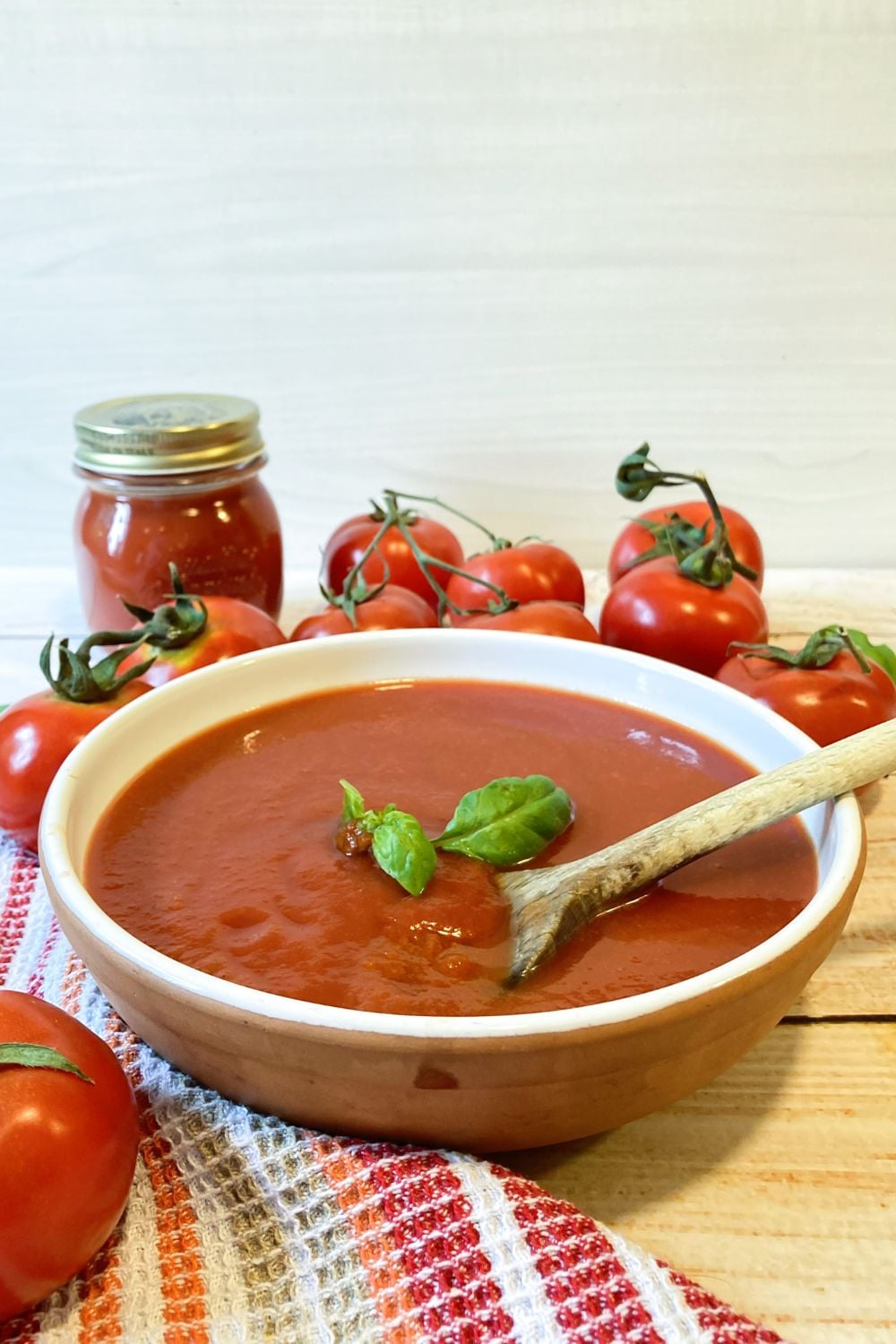
What Are the Best Tomatoes for Passata?
The best tomatoes for homemade passata are ripe, flavorful, and fleshy, with relatively few seeds and not too much water.
San Marzano tomatoes are an excellent choice. Their elongated shape, meaty pulp, rich flavor, and relatively low water content make them particularly well suited for passata.
If San Marzano tomatoes are not available, you can use Roma tomatoes or other plum and paste tomato varieties with similar characteristics. The variety matters, but the quality and ripeness of the tomatoes matter even more.
Choose tomatoes that are deep red, fully ripe, and naturally sweet and flavorful. Avoid tomatoes that are still firm and pale, as they will produce a less flavorful passata.
If your tomatoes are not quite ripe enough, leave them at room temperature for a day or two before making the passata. Avoid refrigerating them, as cold temperatures can reduce their flavor.
How to Store Homemade Tomato Passata
Fresh homemade tomato passata can be stored in an airtight container in the refrigerator for 3 to 4 days.
For longer storage, freezing is the easiest option. Let the passata cool, then transfer it to freezer-safe containers or jars, leaving some space at the top because the liquid will expand as it freezes. For the best flavor and texture, use frozen tomato passata within about 3 months.
Thaw it overnight in the refrigerator before using.
How to Preserve Tomato Passata Safely
In Italy, homemade tomato passata is traditionally prepared at the end of summer and preserved in glass jars or bottles using a boiling-water pasteurization method. This is the method generations of Italian families have used to preserve their tomato harvest for the winter.
Italian food-safety guidelines note that the natural acidity of tomatoes can vary. For homemade passata, sufficiently acidic tomatoes are recommended; if the tomatoes are not acidic enough, lemon juice or citric acid can be added before preserving.

Step 1) - Take a rather large pot, fill it with cold water, then put a kitchen towel on the bottom. Get hold of some glass jars with vacuum seal button lids. Immerse them in the cold water. Turn on the heat and bring the water to a boil. This way you'll sterilize the glass jars.

Step 2) - After about 10 minutes from the boiling, remove them with kitchen tongs (which you left a few minutes immersed in boiling water to sterilize them) and put the jars to cool on a kitchen towel.
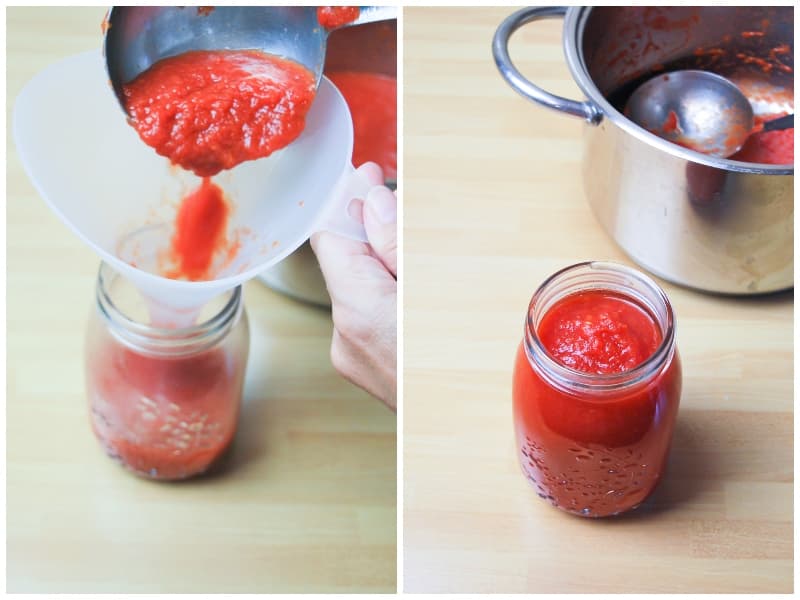
Step 3) - Using a funnel, fill the jars with the tomato passata, leaving about 1 cm (½ inch) of space at the top. Wipe the rims clean and close the jars tightly with clean, undamaged lids.

Step 4) - Place a clean kitchen towel on the bottom of a large pot and arrange the jars inside. Wrap or separate the jars with the towel so that they do not knock against each other during boiling.
Cover the jars completely with water and bring to a boil. Use a lid if necessary.
From the moment the water starts to boil:
- 500 ml jars: boil for at least 35 minutes
- 1-liter jars: boil for at least 40 minutes
Step 5) - Turn off the heat and allow the jars to cool completely in the water. Once cool, remove them and check the lids. The center of each lid should be slightly curved inward and should not make a “click-clack” sound when pressed.
Label the jars with the date and store them in a cool, dry, dark place up to one year.
Discard any jar that has lost its seal or shows signs of swelling, leakage, mold, unusual bubbles, or an abnormal smell. Never taste a questionable preserve to check whether it is safe.
Food safety note: The natural acidity of tomatoes varies. Italian guidelines recommend using sufficiently acidic tomatoes for passata and acidifying with lemon juice or citric acid when necessary. If you follow home-canning guidelines in another country, check your local recommendations, as requirements may differ.
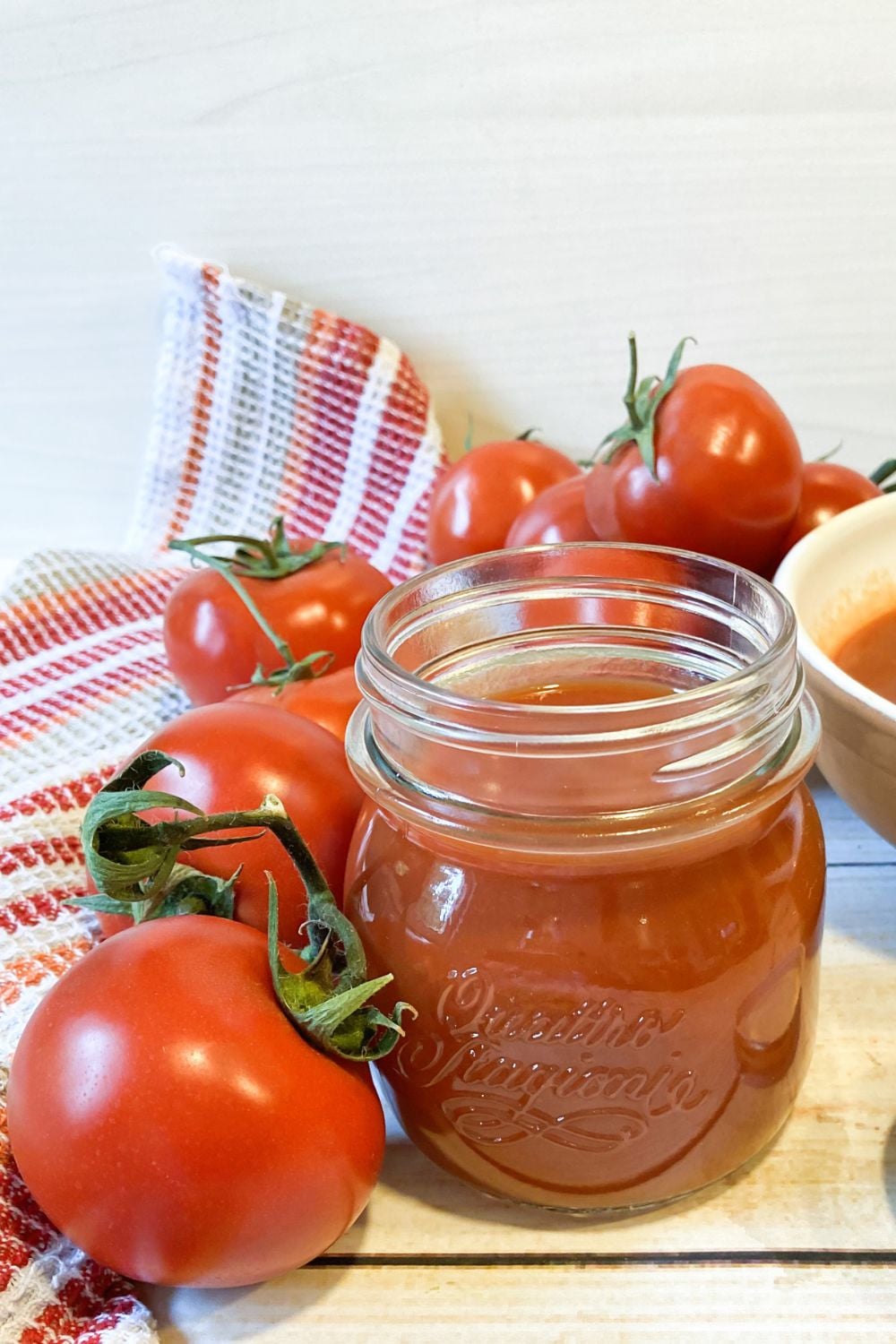
Tomato Passata Variations
Passata Rustica
Passata rustica is a thicker, coarser version of traditional tomato passata, with a more pulpy texture and a rich tomato flavor. It's particularly good for quick pasta sauces, pizza, and recipes where you want the tomato to have a little more texture.
To make it, prepare the tomatoes as described in the main recipe: wash them, cut them in half, and remove the seeds and the most watery inner part.
Cook the tomatoes only until they soften and the skins begin to separate from the pulp. Do not let them completely break down.
Then pass them through a food mill fitted with the disc with the largest holes. This is what gives passata rustica its characteristic coarse, full-bodied texture.
Tomato Passata with Canned Tomatoes
If fresh ripe tomatoes are not available, you can make a quick passata-style tomato purée using good-quality canned whole peeled tomatoes.
Choose canned tomatoes with a short ingredient list, preferably just tomatoes and tomato juice. High-quality San Marzano tomatoes are an excellent choice.
Pass the tomatoes through a food mill to obtain a smooth texture and remove any remaining seeds. If the result is too thin, simmer it gently for a few minutes until it reaches the consistency you prefer.
This version is convenient for cooking, although it won't have exactly the same fresh flavor as passata made from ripe summer tomatoes.
Tomato Passata with Basil
A few fresh basil leaves are sometimes added to homemade passata for a delicate aroma. You can add them to the finished passata before using it, or place a clean basil leaf in each jar if this is part of your usual preserving method.
Keep the flavoring simple: traditional passata is meant to remain a neutral tomato base that can later be seasoned according to the recipe you are preparing.
How to Use Tomato Passata
Tomato passata is one of the most versatile ingredients in Italian cooking. Its smooth texture and pure tomato flavor make it an excellent base for many recipes, especially when fresh tomatoes are not in season.
You can use tomato passata to make pasta sauces, such as Penne alla Vodka, Bolognese Sauce, or Marinara Sauce.
It's also perfect as a base for pizza, baked pasta dishes, soups, stews, and sauces for meat or fish.
Because passata is simply tomato without added seasonings, you can easily customize it with extra virgin olive oil, garlic, onion, basil, oregano, or other ingredients depending on the recipe you are preparing.
What Is Tomato Passata?
The Italian word “passata” comes from the verb passare, which in cooking can mean to pass or press food through a sieve, food mill, or similar tool.
The name refers to the traditional method used to make it: cooked tomatoes are passed through a tomato strainer or food mill to separate the smooth pulp from the skins and seeds. In Italian, passata di pomodoro literally refers to tomatoes prepared in this way.
Unlike a seasoned tomato sauce, passata is simply smooth, uncooked or briefly cooked tomato purée with no chunks, skins, or seeds. It's used as a basic ingredient in countless Italian recipes.
Tomato Passata vs Tomato Sauce vs Tomato Purée
Tomato passata is often confused with tomato sauce and tomato purée, but they are not exactly the same.
Tomato passata is made from tomatoes that are strained to remove the skins and seeds, resulting in a smooth, pourable consistency. It's usually unseasoned and is used as a base for sauces, soups, stews, pizza, and many other Italian dishes.
Tomato sauce is generally a finished or partially cooked sauce. It may contain olive oil, garlic, onion, herbs, salt, or other seasonings, depending on the recipe. You can see exactly how this works in our Tomato Sauce from Fresh Tomatoes recipe.
Tomato purée can be a little more confusing because the meaning varies by country. In the United States, tomato purée is usually thicker and more concentrated than passata. In the UK and some other countries, the term may refer to a much more concentrated tomato product, similar to what Americans call tomato paste.
So, if an Italian recipe calls for passata di pomodoro, look for a product labeled tomato passata, strained tomatoes, or a smooth, unseasoned tomato product with a similar consistency.
For a more detailed explanation of Italian tomato products, see our guide to the differences between tomato passata, tomato sauce and tomato paste.
More Italian Tomato Recipes
- Pappa al Pomodoro
- Spaghetti al Pomodoro
- Italian Tomato Risotto (Risotto al Pomodoro)
- Classic Bruschetta with Tomato and Basil
Recipe Card

Homemade Tomato Passata Recipe (Passata di Pomodoro)

Ingredients
- 2 Kg tomatoes - 4 lb 6 oz of very ripe, flavorful tomatoes, such as San Marzano, Roma, or other good-quality sauce tomatoes
Instructions
- Choose very ripe, red tomatoes without bruises or damaged areas. Wash them thoroughly under running water, remove the stems, and cut them in half.
- Using a small knife or spoon, remove the seeds and the very watery inner part of each tomato. This step helps prevent the passata from becoming too watery and, more importantly, ensures a smoother, seed-free texture. This is especially useful if you are using a food mill, as some seeds may otherwise pass through. Place the prepared tomatoes in a large pot.
- Cover the pot and cook the tomatoes over low heat for about 15 to 20 minutes, stirring occasionally. Do not add any water: the tomatoes will release plenty of their own juices as they cook. They are ready when they are very soft and beginning to break down.
- Transfer the cooked tomatoes, a few ladlefuls at a time, to the tomato strainer. Gently push them through with the stomper. The skins and any remaining seeds will be separated from the pulp, while the smooth tomato passata will collect underneath.
- If the passata is still more liquid than you prefer, let it drain briefly through a fine-mesh strainer, stirring gently with a spoon, until it reaches the desired consistency.
Notes
- 500 ml jars: boil for at least 35 minutes
- 1-liter jars: boil for at least 40 minutes


Jean-Francois ROSSI says
I remember my Mum doing something like this when I was little and after pouring the sauce in bottles, she used to top the sauce with some olive oil and then closing the bottles with nothing else than just paper and a string.
Laureen Romey says
I grew San Marzano tomatoes for the last two summers and used them to make this recipe. Absolutely delicious! Thank you.
George Rollings says
My wife and I fell in love with Cirio Passata Rustica while we were in Knightdale NC that we purchased from Food Lion that was imported from Italy. However, we are now in Albany OR and Passata is nearly impossible to find. Hence, I “googled” Passata recipe and found your recipe!
DD says
Amazon has the Cirio AND the Cento brand. I use the Cento brand, but have never tried the Cirio. Good luck!
Annie says
I made this Passata yesterday and it turned out perfectly. You are definitely correct that by removing the seeds and the juice the sauce is thicker. I ended up giving the tomato halves a squeeze (like you do with lemons) and the process was quicker. I used my Moule on the finest attachment. It was all very very easy. I took photos to show you but I can’t upload them here .. wish I could. Give this a go, you’ll surprise yourselves. 10/10 and thank you so much for the recipe - very grateful xx
Emma says
Hello, I am wondering if the same results can be achieved by only using a metal sieve/strainer if you have no machine or mill? Thank you.
Barbara McMahon says
Yes. It needs to be fine to catch all the seeds
Yvonne says
We love your Passata recipe and have made it three times this year! It is so lovely. We followed your recipe with no changes each and every time--all jars sealed ----nothing broken and the taste is unbelievable! So much tastier than the jarred stuff I used to purchase! This recipe and your directions are keepers!!!!
Thank you again for sharing this great recipe Barbara.
Yvonne
Barbara says
Thank you for your comment Yvonne!
Leonard R Ciancaglini says
most italians i know that do this every summer don't boil the tomato in the jars. after step one of cutting and heating and step two putting them through the machine, they cook the pulp again up to one hour and then to the jar. they do not boil the tomato in the jar. they cover with a blanket and let them sit overnight upside down.
Dick doman says
HI PAUL I agree if the jars are sterilised its the same as making chutney,keep it simple. DICK
Mr Paul Freeman says
If you are putting it in sterilized jars, then boiling the jars until the contents are sufficiently hot to be rendered sterile, why would you not just bring the sieved mixture in the pan gently to a boil and jar it with screw sealed lids like you would jam?
A lot less fuss!
pandy says
The jars will have germ on, sterilising them is the only way to make sure your passata stays fresh, that goes with anything you wish to keep in a jar for a long time. An easy way to sterilise a jar is to put it in a hot oven for 20 mins. Make sure the jars are safe to do this, ie made for the job
Stef says
That is not a safe way to process jam, either! When making jam you need to sterilize the jars before filling with the hot jam and then still process them in a water bath for 10-15 minutes depending on the recipe. The only difference I see in this recipe and the standard for safe jam processing is the type of jar lid used. (New button-topped one-piece lids are a completely valid option, although less common and pricier than two-part flat lids and collars)
More of a concern is that not all tomatoes have the correct ph for safe water bath processing, and it is very difficult to test for in a home setting. This can be offset by the introduction of citric acid, bottled lemon juice, or vinegar, but that would impact the flavor.
Freezing or fridge-storing for shorter periods may be the best options if you want to avoid adding acid to the passatta.
Rosemary M says
As a retired (FDA recognized)) thermal processing specialist, I am very concerned by the individuals suggesting not processing the passata after putting it in a jar. I agree with Stef that if one is not going to acidify the passata (and confirm the pH is less than 4.0), only freezing or refrigerating is approriate for storage. While it is true that our grandmothers were able to safely store hot filled tomatoes, the pH of today's tomatoes (particularly the hybirds most people grow today) are not acidic enough for that treatment.
Virginia Bird says
I am using Glass Jars with Metal Plastisol Lined Lug Lids - do I follow the same procedures for the water bath?
Marina says
The jars are no longer sterile if removed as shown, with one blade inside and one outside. Better to have a pair of tongs that has a wide enough spread to grab on both sides of the jar.
SJ Stewart says
Sterilize the tongs
Headley T. says
Also, sterilize the hand that holds the tong
Cheryl says
LOL yes, do!
Mary says
Thank you for sharing!
John says
I quarter the tomatoes, taking out most of the seeds to dry and keep for the following year... I grow Pera D'Abruzzo tomatoes in my garden here in the UK to use, cook as above but I also add a fresh basil leaf to the jar before pouring on the hot tomato passata then sterilising in a hot water bath.
I also use a hand mill which, by the end of the day has given you a good workout!
Barbara says
Great John! Thank you for your comment!
Matthew Wood says
I also quartered the tomatoes and then after removing the insides I blended them and drank the result - Lovely:)
Maria Theresa says
I'm afraid of doing the boiling of tomatoes in glass jar, they may explode or crack. Haven't done it before, just wanted to be safe in the kitchen. Thanks for sharing your tips here. Appreciate it!
Rosemary M says
Always use jars specifically labeled for canning. Never use jars from commmercial products such as pickles, relishes, mayonnaise, etc.!
Anita Smith says
I use 1/4 teaspoon of ascorbic acid per pint (1/2 teaspoon per quart). This will not affect taste but will keep pH at low enough level.
Matt says
Great recipe! Just wondering if there are any tips for what to do with the discarded tomato? Obviously, we can compost, but wondering if there are any useful cooking tips for stocks etc.
Barbara Lucchini says
Hi Metthew,
Thanks for you comment.
Tomato passata waste is made up of skin and seeds. With tomato skin you can make a powder that will flavor or decorate your dishes. Due to the presence of the seeds I do not believe that the result can be satisfactory. In any case you can use a vegetable dryer machine or place the tomato skins in a lined baking tray and let them dry at 100°C for about 2 hours until they are completely dehydrated. Then grind the tomato leaves and reduce them to a powder.
Jules says
I have all that I need to get started on this recipe. I have just one question, if I may? When you put the tomatoes in the saucepan on a low heat on the stove, do they need any additional liquid in the pan or will they create their own juices?
Many thanks in advance
Barbara Lucchini says
Hi Jules!
Don't worry, if they are really ripe they will create a lot of juice.
Any doubt, you can always add half a cup of water at the beginning of cooking...
Cheers! 🙂
Barbara McMahon says
I make tomato passata the way you have described. But to preserve it, I like to dehydrate it to a crunchy bark, blitz it to a powder, and vacuum seal it.
It rehydrates in a flash, and you can vary the consistency by adjusting the amount of liquid (stock,wine,or water) that you use when rehydrating. You can sprinkle it on top of pasta or vegie bakes for a bit of a zing. It is the best way to take tomatoes camping.
Joe says
I'm sure that the Passata recipe is just fine ( though if I have a Victorio food strainer, I'd skip your first 3 steps, run the tomatoes thru the strainer and let it do it's job and then just low heat cook down the remainder to desired consistency) but the preservation technique that you are describing is vague at best and potentially dangerous if people do it wrong. If I understand correctly, you're talking about a hot water bath for preservation:
- Get hold of some glass jars with caps. These need to be canning jars (Mason in the US) with unused caps ... preferably with a separate ring to secure them - otherwise they stand the chance of shattering during processing and making a mess.
- Do NOT boil the new caps / lids! This will serve to soften them enough that they may not take a seal when you actually need to use them. Heating them a bit is all good and fine but a boil will cause you problems.
- Please don't cool the jars after boiling - leave them in the hot water until you need to use them. This way, you're putting like temperatures together and minimizing the chance of cracking the jars when you'd add hot tomato liquid to a cold jar
- For canning, size does matter - both headspace (next comment) and processing times depend on whether you are using pint / quart / larger jars. 40 Minutes might be fine for one but overkill (thus effecting the flavor) or underkill (resulting in lids that pop up rather than stay down due to infection) for another container.
- Headspace - critical for canning ... in this application I'd probably be going with 1/2 inch from liquid to rim but it is also totally dependent on jar size.
- Please suggest to your readers that they just go out and spend a little money on a jar lifter. That way, they can take the jars out of the hot water bath while hot (after boil), put them on a towel and then watch / listen for the signature "ping" when the lids go from flat to concave and show that a good seal has been achieved. If a lid doesn't seal, just use the product like a normal bit of sauce ... it's not worth getting sick if it doesn't.
Passata is great and a totally flexible base - well worth making
Barbara Lucchini says
Hi Joe!
Thank you for your comment. Really useful!
Nigel Darling says
Hi Barbara, love the recipe, I was just wondering if this passata would suit a pizza sauce (Garlic, sugar, olive oil, salt, black pepper and chopped basil added). This sauce recipe tastes great with shop-bought passata but i would love to make it all from scratch!
Thanks,
Nigel
Barbara Lucchini says
Hi Nigel! Tomato passata is a basic recipe suitable for any type of pizza sauce, so I would say it is perfect for your recipe. Thanks for your comment!
Mario Gravina says
Although I used to watch mum make this Passata it was a very long time ago and would like to thank you for reminding of how it's made great memories.
And now I'm back home in Italy i think it's about time I had a go in making it.
Thank you ounce again.
Mario.
Barbara Lucchini says
Thank you for your comment Mario!