
Béchamel sauce, known as besciamella in Italy, is a smooth and creamy white sauce made with butter, flour, and milk, usually seasoned with salt and a little nutmeg.
In Italian cooking, besciamella is an essential ingredient in many classic dishes, especially Lasagna Bolognese, Cannelloni, baked pasta, and vegetable gratins. Its delicate flavor and velvety texture make these dishes creamy without overpowering the other ingredients.

Making Béchamel Sauce from scratch is simple. First, butter and flour are cooked together to make a white roux. Warm milk is then added gradually while whisking until the sauce becomes smooth, creamy, and thick enough to coat a spoon.
The method is easy, but a few details make all the difference: the roux should not brown, the milk should be added gradually, and the sauce needs enough cooking time so it doesn't taste of raw flour.
Follow the steps below to make a perfectly smooth homemade Béchamel Sauce, and learn how to adjust the consistency depending on whether you're using it for lasagna, cannelloni, or other baked dishes.
Jump to:
Kitchen Tools
You only need two basic tools to make Béchamel Sauce:
- A medium saucepan with high sides – preferably stainless steel, so you can easily control the heat while cooking the roux and adding the milk.
- A balloon whisk – essential for incorporating the milk smoothly and preventing lumps from forming.
Ingredients
Prep Time: 5 Min | Cook Time: 15 Min | Yield: about 500 ml (2 cups) Béchamel Sauce
- 500 ml (2 cups + 2 tablespoons) whole milk
- 50 g (1.8 oz) unsalted butter
- 50 g (1.8 oz) all-purpose flour
- ¼ teaspoon salt
- Freshly grated nutmeg, to taste
How to Make Béchamel Sauce
Make the Roux
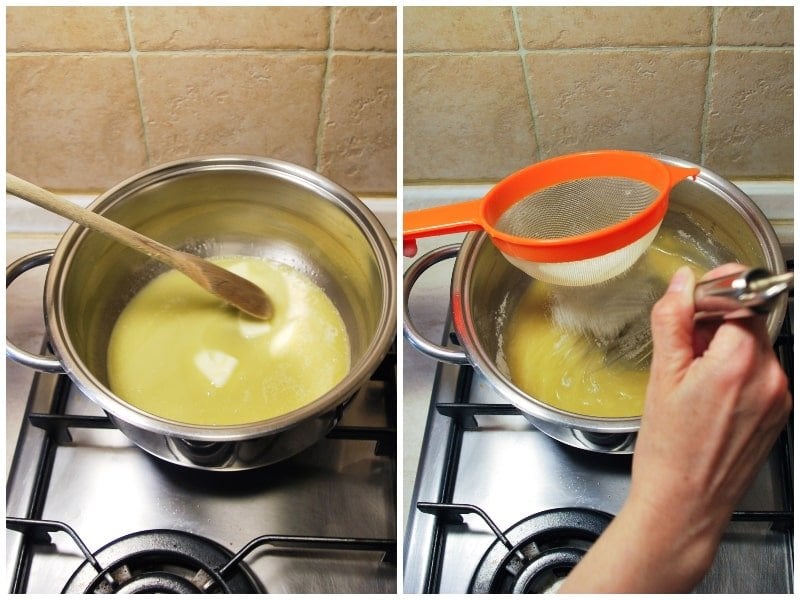
Step 1) - Melt the butter in a saucepan over low heat. Once completely melted, add the sifted flour.
Whisk immediately until the butter and flour are fully combined and you have a smooth paste with no lumps.
TIP: Sifting the flour before adding it helps it incorporate more evenly into the melted butter and can make it easier to obtain a smooth roux.
Cook the roux over low heat for about 1 to 2 minutes, whisking continuously. It should remain pale and should not brown.
This brief cooking time removes the raw flour taste while keeping the roux light in color, which is essential for a classic white Béchamel Sauce.
Add the Milk

Step 2) - Meanwhile, warm the milk in a separate saucepan. It should be hot but not boiling.
Remove the saucepan with the roux from the heat and add a small amount of warm milk. Whisk vigorously until completely smooth.
Continue adding the milk gradually, whisking well after each addition. Once the mixture becomes smooth and more fluid, you can add the remaining milk in a steady stream while continuing to whisk.
Return the saucepan to low heat.
Cook the Béchamel Sauce, stirring frequently, until it gradually thickens and becomes smooth and creamy.
The sauce is ready when it coats the back of a spoon. When you run a finger through the sauce on the spoon, the line should remain clearly visible.
Season the Béchamel Sauce

Step 3) - Remove from the heat and season with salt and freshly grated nutmeg to taste.
Your homemade Béchamel Sauce is now ready to use in lasagna, cannelloni, baked pasta, vegetable gratins, and many other dishes.
For a richer variation, you can stir in a little finely grated Parmigiano Reggiano while the sauce is still hot. This is optional and is not necessary for a classic Béchamel Sauce.

Tips for Perfect Béchamel Sauce
Keep the heat low. Béchamel Sauce should cook gently. High heat can make the roux brown too quickly or cause the milk to stick to the bottom of the saucepan.
Do not brown the roux. Cook the butter and flour just long enough to remove the raw flour taste. For a classic white sauce, the roux should stay pale.
Use warm milk. Adding warm milk to the roux makes it easier to create a smooth sauce and helps the ingredients combine evenly.
Add the milk gradually at first. Pour in just a small amount and whisk until completely smooth before adding more. Once the mixture becomes fluid, you can add the remaining milk more quickly.
Whisk thoroughly, especially around the edges of the saucepan. Flour can collect along the sides and bottom, so make sure you reach every part of the pan while the sauce is thickening.
If lumps form, don’t worry. Whisk the sauce vigorously while it's still hot. If necessary, pass it through a fine-mesh sieve before using it.
Season at the end. Add salt and freshly grated nutmeg once the sauce has reached the right consistency. This makes it easier to adjust the flavor without over-seasoning it.
How to Adjust Béchamel Sauce Consistency
The amount of butter and flour determines how thick your Béchamel Sauce will be. The recipe above gives you a classic, medium-thick consistency, suitable for most Italian dishes.
If you prefer a more fluid Béchamel, reduce the amount of butter and flour while keeping the same quantity of milk. For a thicker sauce, increase both.
For 500 ml (2 cups + 2 tablespoons) of milk, use:
- Thin Béchamel: 30 g (1.1 oz) butter + 30 g (1.1 oz) flour
- Classic Béchamel: 50 g (1.8 oz) butter + 50 g (1.8 oz) flour
- Thick Béchamel: 70 g (2.5 oz) butter + 70 g (2.5 oz) flour
A thinner Béchamel is useful when you want the sauce to spread easily between layers of pasta or lightly coat ingredients. The classic consistency works well for lasagna, cannelloni, and most baked pasta dishes. A thicker Béchamel is better when you need a sauce that holds its shape or binds ingredients more firmly.
In this method, butter and flour are used in equal weights to make the roux. You can then adjust the total amount of roux according to the consistency you need.
Béchamel Sauce Variations
Classic Béchamel Sauce is made with butter, flour, milk, salt, and nutmeg, but you can easily adapt it depending on the dish you're preparing.
With Parmigiano Reggiano. Stir in a little finely grated Parmigiano Reggiano while the sauce is still hot for a richer, more savory flavor. This variation works especially well in baked pasta, vegetable gratins, and lasagna.
With black pepper. Add a small amount of freshly ground black pepper together with the nutmeg for a slightly more pronounced flavor.
Without nutmeg. Nutmeg is traditional, but you can simply leave it out if you prefer a more neutral sauce.
How to Use Béchamel Sauce
Béchamel Sauce is one of the most useful basic sauces in Italian cooking. Its mild flavor and creamy texture make it ideal for baked pasta dishes, where it adds moisture and helps bind the other ingredients together.
Besides classic lasagna and cannelloni, you can use homemade béchamel in many other Italian recipes:
- Pasta al Forno – béchamel is combined with Bolognese sauce and mozzarella for a rich and creamy baked pasta.
- Spinach and Ricotta Lasagna – the sauce keeps the layers soft and creamy and balances the spinach and ricotta filling.
- Lasagne alla Ligure – béchamel pairs beautifully with pesto, potatoes, green beans, and Parmigiano Reggiano.
- Pumpkin Lasagna – its delicate flavor complements the sweetness of pumpkin without overpowering it.
Béchamel is also excellent for vegetable gratins, other baked pasta dishes, and recipes that need a creamy sauce to bind the ingredients and create a golden crust in the oven.

Storage
You can prepare Béchamel Sauce ahead of time and store it in the refrigerator for up to 3 days.
Let the sauce cool, then transfer it to an airtight container or bowl. Cover the surface directly with plastic wrap, pressing it gently against the Béchamel. This prevents a skin from forming on top as the sauce cools.
Béchamel Sauce can also be frozen for up to 1 month. Let it cool completely before transferring it to a freezer-safe container. Thaw it overnight in the refrigerator before reheating.
How to Reheat Béchamel Sauce
Reheat the sauce gently in a saucepan over low heat, stirring constantly with a whisk.
If the Béchamel has become too thick after chilling, add a small amount of milk, a little at a time, and whisk until it becomes smooth and creamy again.
If a thin skin has formed on the surface, it's best to remove it before reheating rather than mixing it back into the sauce.
Origins of Béchamel Sauce
The origins of Béchamel Sauce have long been debated between Italy and France.
According to a popular Italian tradition, an early version of the sauce originated in Tuscany and was later brought to France in the 16th century by Caterina de' Medici. This story is still widely repeated, but modern food historians have not found enough documentary evidence to consider it an established historical fact.
What is better documented is the French origin of the name Béchamel, from sauce à la Béchamel. By the late 18th century, however, besciamella was already firmly established in Italian cooking. Francesco Leonardi included it in his Apicio Moderno, recommending it for dishes such as lasagna, macaroni, gnocchi, ravioli, polenta and vegetables.
Later, Pellegrino Artusi called the sauce “Balsamella” in his famous 1891 cookbook, creating an Italian alternative to the French name. The term never replaced besciamella, which became the standard Italian name.
So, while the frequently repeated Tuscan origin cannot be proven, Béchamel Sauce has been part of Italian cooking for centuries and remains an essential sauce in many traditional Italian dishes.
Recipe Card

Béchamel Sauce (Besciamella) – Italian White Sauce Recipe

Ingredients
- 500 ml whole milk - 2 cups + 2 tablespoons
- 50 g unsalted butter - 1.8 oz
- 50 g all-purpose flour - 1.8 oz
- ¼ teaspoon fine salt
- freshly grated nutmeg - to taste
Instructions
Make the Roux
- Melt the butter in a saucepan over low heat.
- Once completely melted, add the sifted flour.TIP: Sifting the flour before adding it helps it incorporate more evenly into the melted butter and can make it easier to obtain a smooth roux.
- Whisk immediately until the butter and flour are fully combined and you have a smooth paste with no lumps.
- Cook the roux over low heat for about 1 to 2 minutes, whisking continuously. It should remain pale and should not brown.This brief cooking time removes the raw flour taste while keeping the roux light in color, which is essential for a classic white Béchamel Sauce.
Add the Milk
- Meanwhile, warm the milk in a separate saucepan. It should be hot but not boiling.
- Remove the saucepan with the roux from the heat and add a small amount of warm milk. Whisk vigorously until completely smooth.Continue adding the milk gradually, whisking well after each addition. Once the mixture becomes smooth and more fluid, you can add the remaining milk in a steady stream while continuing to whisk.
- Return the saucepan to low heat.
- Cook the Béchamel Sauce, stirring frequently, until it gradually thickens and becomes smooth and creamy.The sauce is ready when it coats the back of a spoon. When you run a finger through the sauce on the spoon, the line should remain clearly visible.
Season the Béchamel Sauce
- Remove from the heat and season with salt and freshly grated nutmeg to taste.


Emily R. says
This béchamel sauce recipe is perfect! Smooth, creamy, and easy to follow. I’ve tried many versions over the years, but this one finally gave me the ideal texture with no lumps at all. I used it for lasagna and it turned out amazing. Definitely my go-to recipe from now on.
Gemma says
Yum! This is how my GG made Her Besciamella for Lasagna. She always said her "trick" was, the best Butter makes the best Besciamella, and always sift your flour lol. I still get big compliments on my Lasagna or whenever I make Cannelloni. It's the sauce! Thank you for posting. Brings back memories of being in the kitchen with my GG ❤️
John L Brandolini says
The ingredients in this recipe are identical to the ingredients I use when making bechamel; however, my technique is different when making the roux. I heat the butter and flour until it starts to bubble then I turn the heat down low and cook the roux for 2 minutes while stirring it constantly to prevent browning. Then I add the warm milk to the roux and cook it it until it thickens. The whole process takes about 7 minutes and I get a nice creamy white sauce. It becomes a base for the sauce I use for mac and cheese using pecorino romano, parmigiano reggiano, and sharp white cheddar. If adding cheese to the bechamel I would recommend avoiding adding salt as cheese is naturally salted.
Beau says
This is the bomb! I use this recipe exclusively for any lasagne. And i'm making 1.5 ltrs per time. Only tip l suggest is to infuse the milk. I heat mine with added bay leaves and peppercorns. Stunning. Don't forget the nutmeg! Fresh is best!!
Anonymous says
This was like a shortbread cookie of sauces! I didn't add anything like garlic or cheese and it was very plain. I would recommend adding much more salt than is listed if you plan to eat it just sauce and noodles.
Alicia says
Haven’t made béchamel in years so needed a refresher recipe. Going to make it tonight and add some sautéed bacon pieces - yes pancetta would be better- some chives from my garden and some minced garlic and onion, served over cheese ravioli and some diced chicken breasts.
Nadien Lucas says
Thank you for this recipe, the sauce complimented my lasagne beautifully.
What a difference the nutmeg made.
Teagen says
Turned out delicious, but we ended up needing to increase the heat to medium before it would thicken up
Rose says
I added homemade basil pesto and served it over mushroom ravioli! Sooooo good!
Ana Niederkorn says
Bechamel sauce is also a great base for making croquettes. While it’s still líquido add already seasoned ground chicken, ham or fish, etc. and stir until it becomes one mass as you stir it over low heat and you can see the bottom of the pan. Once cooled form into croquette shapes pass through cracker meal and fry on medium heat. Remember it’s already cooked, you just want a golden tone and a crisp on the outside. The inside will be a Heavenly cream that dissolves in your mouth!
EMILIA DINA VANBEUGEN says
How thick did you make the Bechamel so that it becomes solid enough for the kroketten?
Tom says
Make it very thick and then allow it to cool. After you've mixed in some cooked chopped ham or lardons, pour it out onto a tray and place it in the fridge. When it's solid then mould it into tiny rolls, crumb, and fry it 'till golden brown. Drain on some kitchen towel. Serve with lightly chilled amontillado sherry. Enjoy
Isabella Nebel says
Omg this bechamel recipe sounds incredible!
Olivia says
Very easy to replace the flour 1:1 with gluten free flour. I have less of a dairy issue and way more of a gluten issue so make it with Dove's GF flour, whole milk, butter, and grated cheddar or cheddar mozzarella mix.
Last night I made with vegan spreadable butter as it's all I had but worked perfectly.
The only thing I find with gluten free flour is it thickens much quicker. I cook the roux for 1 minute, then if I cook it for 15 mins it'll 1000% burn. It's usually done in about 5 ish mins for me.
Neil says
Made this tonight for a pizza white sauce--added parm reggiano and two garlic bulbs minced up, oh my, DELICIOUS! Thanks for the recipe!
Ursula says
Just a great simple recipe... covering all requirements... (fluidity), love it... it's now my 'go to' Bechamel Sauce recipe. Thank you.
Christopher Jorich says
Drizzle the sauce over crab stuffed shrimp. Broil for 2-3 minutes. This is a five ⭐️ quality plate served in the finest restaurants and hotels.
Natalie Godinez says
I made this recipe and it was delicious. I added fresh sage and it was amazing with chicken. The instructions made it super easy to make and will be using this recipe in the future.