STEP BY STEP PHOTOS ABOVE!Have a look at my step-by-step photo instructions, variations and tips. That way, you can get it perfect the first time you try it!
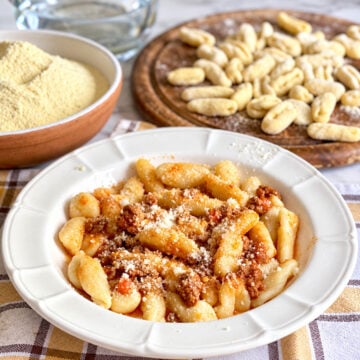
Homemade Cavatelli Pasta Recipe

Cavatelli are a traditional Southern Italian fresh pasta made with durum wheat semolina and water, without eggs. With just a few simple ingredients and a little practice, you can easily make them at home by hand.Cavatelli are especially associated with Molise, although they are also traditional in Puglia, Basilicata, and other areas of Southern Italy. Their name comes from the Italian verb cavare, meaning “to hollow out.” Each small piece of dough is pressed and dragged with the fingers to create the characteristic curved shape and hollow center.
Ingredients
- 400 g semolina flour about 2 ½ cups finely ground durum wheat semolina flour (semola rimacinata)
- 240 g water 1 cup, at room temperature
- ⅓ teaspoon salt fine
Instructions
Make the Dough
- Place the semolina flour in a large bowl. Pour the water a little at a time and add the salt, mixing with a fork.
- Continue adding the water gradually while stirring, until the flour begins to come together and a rough dough forms. Transfer the dough to a work surface and knead it by hand for about 5 minutes, or until smooth and uniform
- Shape the dough into a ball and wrap it in plastic wrap. Let it rest at room temperature for 30 minutes. If your kitchen is particularly warm, you can let the dough rest in the refrigerator instead.
- After the resting time, unwrap the dough and place it on a work surface lightly dusted with semolina flour.Using a dough scraper or a sharp knife, divide the dough into smaller portions. Keep the portions you are not working with covered so they do not dry out.
Shape the Cavatelli
- Roll each portion under your hands to form a long rope about ⅜ inch (1 cm) thick.
- Cut each rope into pieces about ⅜ inch (1 cm) long.
- Now shape the cavatelli. Place your thumb in the center of one piece of dough, press down gently, and drag it toward you across the work surface. The dough will curl around itself, creating the characteristic hollow center.
- As the cavatelli are ready, arrange them in a single layer on a tray or cutting board generously dusted with semolina flour. Keep them slightly apart so they do not stick together. The cavatelli are now ready to cook or store.
How to Cook Homemade Cavatelli
- Bring a large pot of salted water to a boil. Add the fresh cavatelli and cook for about 4 to 5 minutes, depending on their size and thickness.
- The cavatelli will begin to rise to the surface as they cook, but don't rely on this alone to determine whether they're ready. Taste one: it should be tender but still pleasantly firm.
- Drain the cavatelli and toss them immediately with your favorite sauce. I served them with a hearty Italian sausage ragù and grated Pecorino cheese.
Notes
Storage: At Room Temperature
If you plan to cook the cavatelli the same day, arrange them in a single layer on a tray generously dusted with semolina flour. Leave them at room temperature for 1 to 2 hours, making sure they don't overlap or stick together.In the Refrigerator
Uncooked cavatelli can be stored in the refrigerator for about 1 day. Arrange them in a single layer on a semolina-dusted tray or place them in an airtight container, separating layers with parchment paper and a little semolina. Make sure the cavatelli are fairly dry before covering them, as excess moisture can make them sticky.In the Freezer
Freezing is the best option if you want to keep homemade cavatelli for longer. Arrange the uncooked cavatelli in a single layer on a semolina-dusted tray, making sure they don't touch. Freeze for about 1 to 2 hours, until firm, then transfer them to a freezer bag or airtight container. They will keep well for about 1 month. Cook frozen cavatelli directly in boiling salted water without thawing them first. They may need an extra minute or two of cooking time.How to Store Cooked Cavatelli
Cooked cavatelli are best enjoyed immediately, but leftovers can be stored in an airtight container in the refrigerator for up to 2 days. Reheat them gently in a skillet with their sauce and, if necessary, add a small splash of water to loosen it. I don't recommend freezing cooked cavatelli, as their texture can become too soft after thawing and reheating. It's much better to freeze them uncooked and cook them straight from frozen.Nutrition
Serving: 100gCalories: 360kcalCarbohydrates: 73gProtein: 13gFat: 1gSaturated Fat: 0.1gPolyunsaturated Fat: 0.4gMonounsaturated Fat: 0.1gSodium: 198mgPotassium: 186mgFiber: 4gCalcium: 19mgIron: 4mg
Tried this recipe?Mention @recipesfromitaly or tag #recipesfromitaly!